


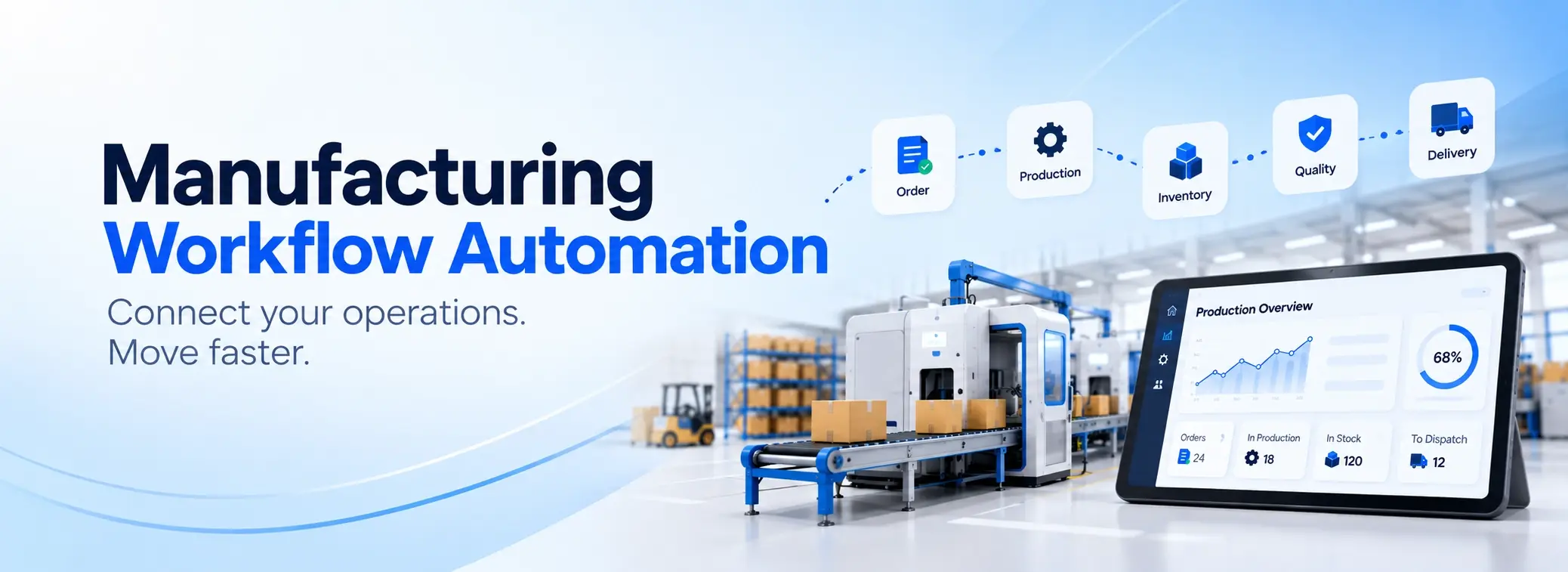
Imagine a manufacturing company where every department is busy.
The production team is working on orders. The warehouse team is checking inventory. The sales team is following up with customers. The finance team is preparing invoices. Managers are checking reports and asking for updates.
From the outside, everything looks productive.
But behind the scenes, employees are spending hours moving information from one spreadsheet to another, sending messages for approvals, checking stock manually, preparing reports, and following up on tasks that should already be part of a system.
This is where Manufacturing Workflow Automation can make a meaningful difference.
Manufacturing is becoming more connected and data driven. Companies are looking for ways to reduce repetitive work, improve visibility, and make their operations more efficient. Workflow automation helps businesses connect everyday processes so that information moves between teams with less manual effort.
What Is Manufacturing Workflow Automation?
Manufacturing Workflow Automation is the use of technology to automate repetitive processes across manufacturing operations.
Instead of relying on employees to manually move information between systems or remind other teams about the next step, automated workflows can trigger actions based on predefined conditions.
For example, when a new production order is created, the system can automatically notify the production team, check available inventory, update the relevant dashboard, and move the order to the next stage.
The objective is not to replace employees.
The objective is to give employees better systems so they can spend less time on repetitive administrative work and more time on activities that require experience, judgment, and problem solving.
The Story of a Typical Manufacturing Business
Consider a growing manufacturing company that receives dozens of orders every week.
A customer places an order with the sales team. The salesperson records the details in a spreadsheet and sends a message to the production manager.
The production manager checks another spreadsheet to understand current production capacity.
Then someone from the warehouse checks whether the required raw materials are available.
If something is missing, the team contacts purchasing.
Once materials are available, production begins.
Later, someone updates the production status manually and informs sales about the progress.
This process may work when the company is small.
But as orders increase, small delays become bigger problems.
One missed update can result in the wrong production schedule. One outdated inventory record can cause unnecessary purchasing. One delayed approval can affect delivery timelines.
The company may not have a people problem.
It may have a workflow problem.
Why Manual Manufacturing Workflows Create Challenges
Manual processes often depend on people remembering what needs to happen next.
This creates several challenges.
Too Much Repetitive Work
Employees may spend a significant amount of time entering the same information into different systems.
Limited Visibility
Managers may need to contact multiple departments to understand what is happening with an order.
Delayed Communication
When information is shared manually through emails, spreadsheets, or messaging platforms, important updates can be missed.
Data Errors
Repeated data entry increases the possibility of incorrect information.
Slower Decision Making
When business information is scattered across different places, managers may not have the right information when they need it.
These challenges can become more noticeable as a manufacturing company grows.
How Manufacturing Workflow Automation Changes the Process
Now imagine the same company using an automated workflow.
A new customer order enters the system.
The workflow automatically sends the order to the appropriate production process. Inventory information is checked. If materials are available, the production team receives the required information.
If materials are below the required level, the system can notify the responsible team.
As production progresses, the status can automatically update.
Managers can see the current position of orders through a central dashboard.
Sales teams can check progress without repeatedly calling the production team.
The workflow becomes connected.
Instead of employees constantly moving information between departments, the system helps information move to the right place at the right time.
That is the practical value of Manufacturing Workflow Automation.
Where Can Manufacturing Workflow Automation Be Used?
Workflow automation can support many areas of manufacturing.
Production Planning
Production tasks can be created and assigned based on incoming orders, capacity, and production requirements.
Inventory Management
Businesses can monitor stock levels and receive alerts when materials reach predefined limits.
Order Management
Orders can automatically move through different stages from confirmation to production and delivery.
Quality Control
Inspection steps can be included in the workflow so that quality checks happen at the appropriate stage.
Approvals
Purchase requests, production changes, and other approvals can be routed to the appropriate person automatically.
Reporting
Production data can be collected and presented through dashboards, reducing the need for manually prepared reports.
The Role of AI Workflow Automation
Traditional automation follows predefined rules.
AI workflow automation can add another layer of intelligence.
For example, an AI powered system can help identify unusual production patterns, summarize operational information, classify incoming requests, or provide insights from business data.
Imagine a manager opening a dashboard and seeing that one production line has experienced repeated delays during a particular stage.
Instead of simply showing numbers, an AI system could help summarize the pattern and highlight where attention may be required.
This does not mean that every manufacturing process needs AI.
AI becomes useful when it solves a specific business problem and works with reliable business data.
The combination of workflow automation and AI can help manufacturers move from simply automating tasks toward creating more intelligent operational systems.
Choosing the Right Workflow Automation Companies
As interest in automation grows, many businesses explore different workflow automation companies.
However, choosing a solution should not be based only on the number of features.
Manufacturers should first understand their existing processes.
Which tasks are repeated every day?
Where are delays happening?
Which teams depend on manual updates?
Where does information get lost?
Which reports take too long to prepare?
These questions can help identify where automation can create practical value.
A good automation approach should fit the way the manufacturing business actually operates.
Building a Smarter Manufacturing Environment
Smarter Manufacturing is not simply about installing new technology.
It is about creating connected processes that help people work more effectively.
A manufacturing company can start with one workflow.
For example, it could automate production order management.
Once the process is working effectively, the company can gradually connect inventory, quality control, purchasing, reporting, and customer communication.
This approach makes automation easier to manage and allows businesses to improve their systems over time.
The goal is not to automate everything at once.
The goal is to automate the right things.
Manufacturing Workflow Automation Is About More Than Technology
The biggest change may not be the software itself.
It may be the way the business operates.
When employees no longer need to spend hours searching for information, following up on routine tasks, or updating multiple spreadsheets, they can focus more on solving problems and improving production.
Managers can spend less time collecting information and more time making decisions.
Teams can work from the same information instead of maintaining separate versions of the truth.
And customers can benefit from more predictable processes and better communication.
That is where Manufacturing Workflow Automation becomes more than an automation project.
It becomes part of a smarter way of running the business.
Conclusion
Manufacturing businesses are under constant pressure to improve efficiency, manage costs, respond faster, and maintain quality.
Manual processes can make these goals difficult as operations become more complex.
Manufacturing Workflow Automation provides a way to connect processes, reduce repetitive work, improve visibility, and help teams make better use of their time.
With traditional automation, businesses can create structured workflows based on predefined rules.
With AI workflow automation, businesses can add intelligence to selected processes where it creates genuine value.
The journey toward Smarter Manufacturing does not have to begin with a complete transformation.
It can begin with one repetitive process, one operational challenge, and one workflow that can work better.
The question is not whether a manufacturing business can automate everything.
The better question is:
Which workflow should your business automate first?
Frequently Asked Questions About Manufacturing Workflow Automation
What Is Manufacturing Workflow Automation?
Manufacturing Workflow Automation uses technology to automate repetitive processes across manufacturing operations. It can help connect production, inventory, approvals, quality control, reporting, and other business processes.
How Does Manufacturing Workflow Automation Improve Efficiency?
It can reduce repetitive data entry, improve communication between teams, reduce manual follow ups, and provide better visibility into operational processes.
What Is AI Workflow Automation In Manufacturing?
AI workflow automation combines automated business processes with AI capabilities. It can help with tasks such as analysing data, identifying patterns, summarising information, and supporting operational decisions.
Can Small Manufacturing Businesses Use Workflow Automation?
Yes. Small manufacturers can start by automating specific repetitive processes such as order management, inventory alerts, approvals, or reporting.
How Do I Choose Between Workflow Automation Companies?
Start by identifying your business processes and specific automation requirements. Look for solutions that can support your existing workflows, integrate with relevant systems, and scale as your operations grow.
Is Manufacturing Workflow Automation Only About Reducing Costs?
No. It can also improve process visibility, reduce repetitive work, support faster decision making, improve communication, and create more consistent business processes.
How Can a Business Start With Smarter Manufacturing?
A practical starting point is to identify one repetitive process that causes frequent delays or requires significant manual effort. Automate that workflow first and gradually connect additional processes as the business becomes ready.