
How Small Manufacturing Businesses Can Compete with Large Enterprises
July 16, 2026
5 minutes

Loading blogs…
Fetching the latest posts
Loading article…
Fetching the latest content for you
July 16, 2026
5 minutes
Written by
Enosh Cherukuru
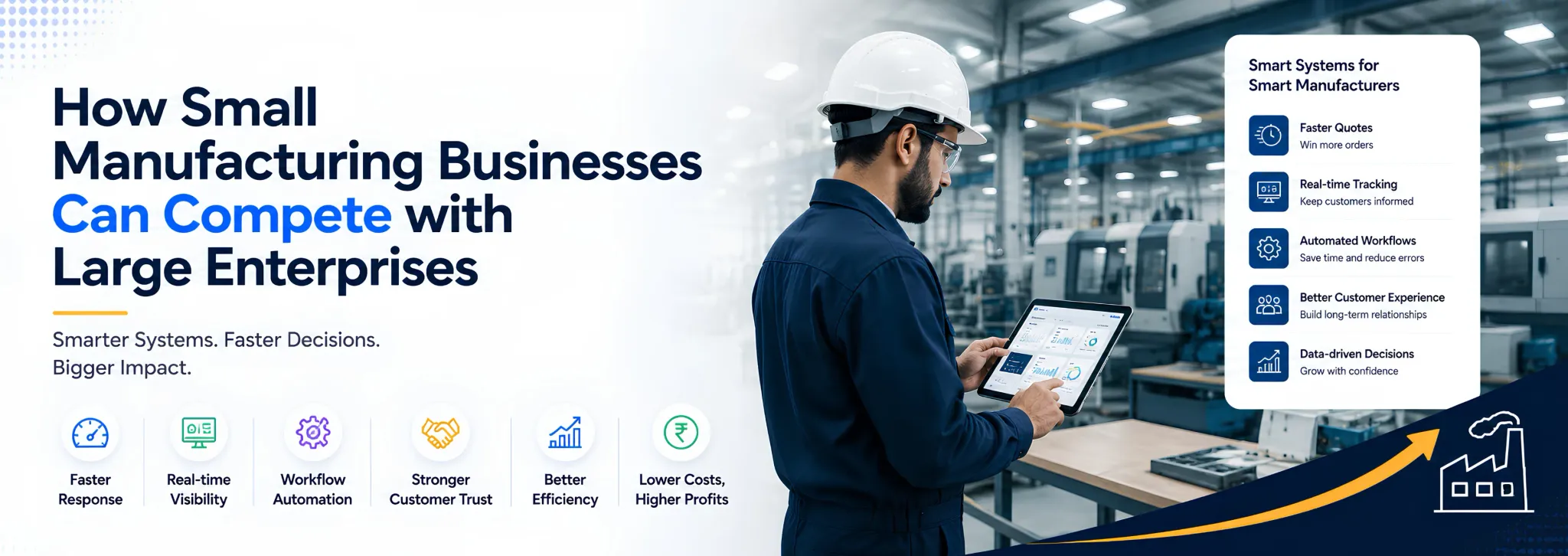
Meena runs an 18-person furniture workshop in Jaipur. For years, she watched her biggest customer slowly shift orders to a large enterprise three states away. Not because that enterprise made better furniture. It replied to RFQs in hours instead of days, tracked every order in real time, and never lost a customer email in someone's inbox. Meena wasn't losing on quality. She was losing on speed and visibility.
This is the quiet story behind most conversations about small manufacturing businesses today. The factory floor skills are often just as sharp as the big players'. What's missing is the hidden layer around the floor: the systems that quote, track, communicate, and follow up while the machines are running. And that hidden layer is exactly where smart manufacturing solutions are closing the gap.
There's a common belief that scale wins by default, that Large Enterprises will always out-produce, out-price, and out-market smaller shops. It's a belief worth questioning. Size brings resources, yes, but it also brings layers: approval chains, old software, and processes built for a thousand people instead of forty. A small manufacturer can often make a decision, change a process, or respond to a customer in the time it takes a large enterprise to schedule a meeting about it.
The real gap isn't skill. It's the systems around the work, the tools that turn a founder's speed and craft into something a customer can actually see and trust. Meena could finish a custom dining set to spec faster than almost anyone in her district. What she couldn't do, at first, was prove that to a new customer who had never worked with her before, because her quoting process lived in someone's notebook and her delivery timelines lived in her head.
That's the part large enterprises solved decades ago, with costly ERP systems and full operations teams. It's also the part small manufacturing businesses can now solve too, without the high cost.
Small manufacturing businesses can compete by adopting smart manufacturing solutions and manufacturing workflow automation. These tools improve response times, order tracking, customer communication, and operational efficiency without requiring a large investment.
Smart manufacturing solutions use technologies such as automation, AI, real-time dashboards, and inventory tracking to streamline production processes. They help manufacturers reduce manual work, improve productivity, and make faster business decisions.
Manufacturing workflow automation eliminates repetitive manual tasks like quote generation, order updates, and customer notifications. It reduces errors, speeds up operations, and allows employees to focus on production instead of paperwork.
AI helps small manufacturers automate routine tasks, improve production planning, monitor machine performance, and build custom business applications faster. It enables small businesses to operate more efficiently and compete with larger manufacturers.
Small manufacturers should begin by automating the processes that cause the most delays, such as RFQ responses, order tracking, customer follow-ups, or inventory management. Starting with one key process delivers quick results and makes future automation easier.
Yes. Automation reduces manual errors, minimizes repetitive work, improves resource utilization, and speeds up operations. Over time, these improvements lower operating costs while increasing productivity and customer satisfaction.
Enosh Cherukuru
Enosh Cherukuru shares practical guidance on AI-powered workflows and product delivery.

Manufacturing
Read insights and updates from Dhumi.

Manufacturing
Read insights and updates from Dhumi.

Manufacturing
Read insights and updates from Dhumi.
It helps to look at the two side by side, honestly, without assuming bigger is always better.
| Factor | Large Enterprises | Small Manufacturing Businesses |
|---|---|---|
| Production capacity | High volume, multiple facilities | Lower volume, single facility, but flexible |
| Decision speed | Slower, multi-layer approvals | Fast, often same-day |
| Customer relationships | Managed by account teams | Direct, founder or manager involved |
| Technology budget | Large, dedicated IT teams | Limited, needs simple tools |
| Response time to RFQs/queries | Can be slow without automation | Can be near-instant with automation |
| Customization ability | Rigid, standardized processes | Naturally flexible |
| Order tracking & reporting | Enterprise ERP systems | Often manual, spreadsheets, calls |
| Brand visibility online | Strong, established SEO and ads | Often weak or missing |
Look closely at where the real disadvantage sits. Not on the shop floor, but in tracking, reporting, response time, and visibility. Those are exactly the areas that manufacturing workflow automation and simple smart manufacturing solutions can fix, without needing a big budget.
It's worth sitting with that table for a moment. Every row where the small manufacturer already wins, decision speed, customer relationships, flexibility, is a row about people. Every row where the large enterprise wins is a row about systems. That's a problem you can fix, not a fact you have to live with.
Meena's workshop didn't need a new machine. It needed three things: a way to quote faster, a way to track jobs without ten WhatsApp threads, and a way to show up when customers searched online. That mix, simple smart manufacturing solutions plus manufacturing workflow automation, is what let an 18-person workshop start acting like a much bigger one, at a fraction of the cost.
Here's roughly what changed for her workshop over about six months, and how it compared to doing nothing:
| Area | Before (manual) | After (smart tools + automation) |
|---|---|---|
| RFQ response time | 2-3 days | Same day |
| Order status visibility | Phone calls to the floor | Live dashboard, shared with customer |
| Repeat order handling | Re-typed from scratch | Auto-generated from templates |
| Missed follow-ups | Frequent | Rare, automated reminders |
| Online enquiries | Almost none | Steady monthly leads |
None of this required Meena to out-produce the large enterprise down the road. It just meant she stopped losing to it on things that had nothing to do with the quality of her furniture. The first customer who noticed was, oddly enough, the one she had almost lost. When the RFQ reply landed in his inbox the same afternoon, with a clear price breakdown and delivery date, he called Meena directly to ask what had changed. She told him the truth: nothing in the workshop had changed at all.
Automation sounds like a big, costly word, but in a small manufacturing business it usually means something small: a quote gets made automatically when a customer fills a form, a job status updates itself as it moves through stages, an email goes out when an order ships, instead of someone remembering to send it. None of these steps need a robot arm. They need a workflow that runs quietly in the background so the owner and the floor team can focus on making things, not chasing paperwork.
This is also where AI tools have started to matter for smaller shops, not as some far-off upgrade, but as a real way to build that quoting page, that tracking dashboard, or that customer portal without hiring a software team. A shop that once needed months and a developer can now put together a working tool in days, using AI app-building platforms made for exactly this kind of quick build. For Meena, the whole quoting and tracking system was built and running before her rival down the road had even finished its next review meeting.
There's also a quiet benefit that doesn't show up in a spreadsheet right away: fewer mistakes. Manual processes fail quietly, a missed follow-up, a wrong quantity typed into an email, an order that slips through because nobody flagged it. Automation doesn't stop every error, but it removes the ones caused by simple human forgetfulness, which turns out to be most of them.
The biggest shift over the past few years isn't in production capacity. It's in how quickly a small manufacturer can now match enterprise-level speed once basic automation is in place. Picture two lines, one for large enterprises and one for small manufacturers, plotted against "customer response speed" over the last five years. The enterprise line stays fairly flat, they were already fast, and there's a limit to how much faster a large organization can move. The small manufacturer line, once low and flat, has been climbing steadily and is now crossing over in many cases, because smart manufacturing solutions cost far less than they used to and take days, not months, to set up.
That crossover is the real story small manufacturing businesses should be watching. It's not that small shops have suddenly grown bigger. It's that the tools once kept for big shops have become small enough, cheap enough, and fast enough to set up, that size stopped mattering for this fight.
It's worth asking why something as plain as a faster quote or a tracking dashboard changes a customer's mind. The answer is trust. A buyer placing an order with a small manufacturer is taking on a small amount of risk: will this shop deliver on time, will they speak up if something goes wrong, will the order actually be tracked properly. Large enterprises have long won that trust simply by looking organized: a clean portal, a status update, a process you can predict.
When a small manufacturer picks up the same kind of visible structure, even a simple one, that sense of risk drops right away, often before a single piece has even been made. Meena's customers didn't start trusting her more because her joinery got better. They started trusting her more because they could finally see what was happening to their order without having to call and ask.
That's a small but useful point for any small manufacturing business thinking about where to spend first: the payoff isn't only in how the work gets done, it's also in how safe the customer feels while it happens.
Meena didn't change everything at once. She started with the RFQ process, because that was where she was losing the most ground. Then she added order tracking. Then a simple online presence so customers searching for her kind of work could actually find her. Each step was small, cheap, and easy to undo if it didn't work. None of it meant competing with Large Enterprises on their terms. It meant making her own strengths visible.
A good way to pick the order: fix whatever is causing the most lost business first, not whatever looks most impressive. Order tracking dashboards look great in a pitch deck, but if the real problem is a two-day quote turnaround, that's the fire to put out first. Order matters more than ambition here. A small manufacturer with one working automation beats one with five half-finished ones.
It's also worth remembering that none of this needs to happen overnight, or alone. Most of these tools are made to be set up by a non-technical team over a few days, with support along the way, rather than needing a full IT department. That, more than anything, is what makes the fight with Large Enterprises fair again. Not matching their size, but matching their speed and visibility with tools built for a much smaller team.
A year on, Meena's workshop hasn't grown into a large enterprise, and it doesn't need to. What changed is that customers now see a workshop that responds quickly, tracks orders properly, and shows up when they search for the kind of furniture she makes. The workshop floor is the same. The craft is the same. The only thing that changed is that the outside world can finally see it clearly.
If your shop is facing the same gap Meena did, Dhumi's manufacturing solutions are built for exactly this: real-time inventory tracking, machine monitoring, and production dashboards that let a small manufacturing business run with the same speed and visibility as a large enterprise, without the large price tag.
The easiest way to find a profitable niche is to look at the small batch or custom orders large enterprises usually turn away, since that gap is where a small manufacturer can build a strong reputation. Talking directly to existing customers about what they cannot get elsewhere often points straight to that opportunity.
Supply chain management tools let small manufacturers track materials, suppliers, and orders in one place instead of relying on phone calls and memory, so stock shortages and late suppliers get caught before they cause delays. This steady visibility means fewer stalled machines and fewer rushed, costly orders.
Good customer service mostly comes down to quick, honest communication, telling customers where their order stands at each key stage instead of leaving them to wonder. Small producers also have the advantage of speaking to customers directly, without a call center in between, which builds trust faster.
Good starting points include food processing, garment or textile units, small metal fabrication, and packaging or plastic molding, since all of these have steady demand and can begin with modest equipment. It is best to start narrow with one product line and expand only once orders are steady.