
Top 10 Benefits of Using AI in Website Development
July 1, 2026
12 minutes

Loading blogs…
Fetching the latest posts
Loading article…
Fetching the latest content for you
July 1, 2026
12 minutes
Written by
Channa Basava Rajan
A website was once deemed good based on its appearance and loading speed. Now, the standards have shifted. Today's websites must have the ability to analyze their users in real time, protect themselves from fraudulent activities, and maintain good rankings even without the need for an SEO team constantly watching over them. AI in Web Development has been responsible for raising those standards, and all the while staying under the radar within the very platforms and tools that developers and marketers already use.
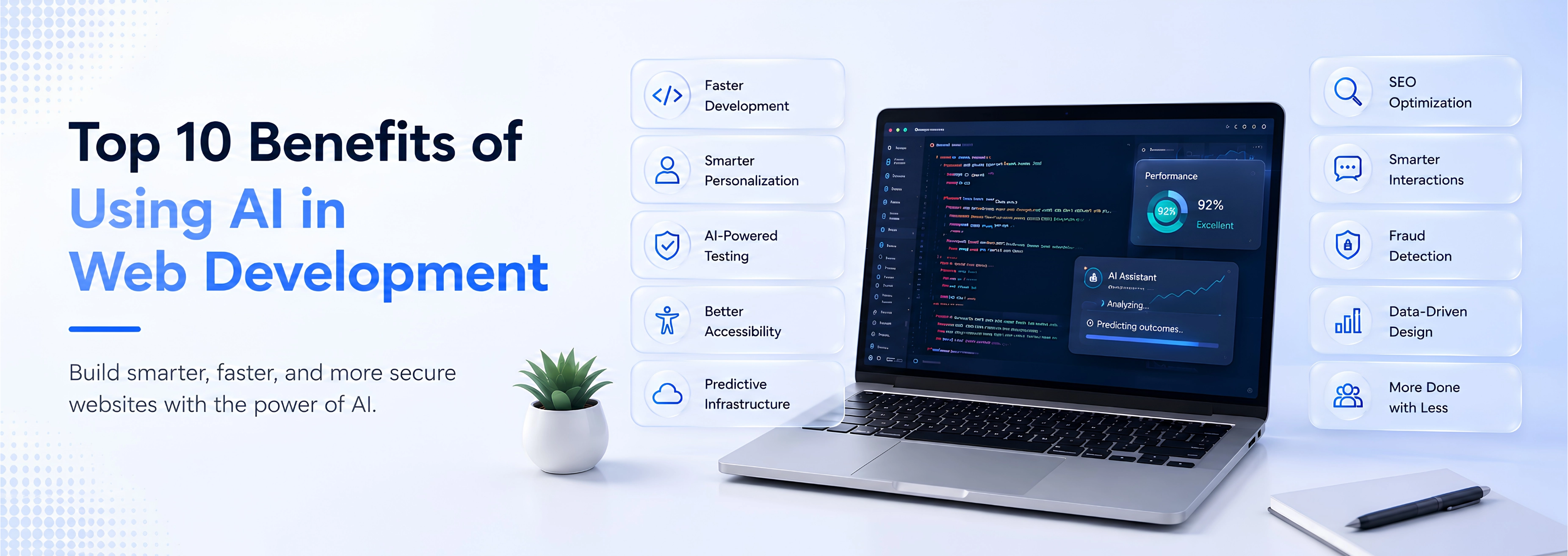
AI in Web Development does not represent any threat to website developers' jobs. This technology helps them out in performing routine tasks, analyzing data, and making choices. What follows is a list of ten ways in which artificial intelligence improves website development, and what that implies for a company's website in each case.
AI coders today do quite an important amount of work that is involved with building scaffolding, writing repetitive code, giving suggestions, as well as pointing out bugs before even moving on to staging. The developers still have their part to play, but all the hard labor involved has been done away with. With the use of AI in Web Development, teams are releasing features within days when it previously used to take months, and this is most relevant to companies who wish to test their ideas fast.
Channa Basava Rajan
Channa Basava Rajan shares practical guidance on AI-powered workflows and product delivery.
On a static website, there is always just one homepage for everybody to see. In an AI-powered website, that’s not always the case. AI makes use of data about the browsing history, referral source, purchasing history, and behavior on the website to customize the content that each visitor gets served in different hero banners, rearranged product grids, and personalized recommendations, without requiring anyone to create segments manually.
Manual QA will test the website once, while the automated tool will test the site continuously, looking out for broken links, layout changes, accessibility problems, and performance regression each time there is an update to the code. In contrast to the pre-launch rush where problems only arise before launching the site, problems become known the instant they appear, making the process less stressful.
For accessibility features to be implemented in a website, the process relied on the developer ensuring that alternative text is added to elements, checking contrast ratios, and ensuring proper structuring for screen readers. The advent of AI now does much of this through automatically generating descriptions of images in alt text format, warning developers when there are low-contrast colors being used, and offering suggestions for changes needed in terms of proper structuring.
Traffic increases meant either paying for too much server power that went unused most of the time or frantically reacting to your page becoming an overnight sensation by crashing. Now, through artificial intelligence monitoring tools, companies can predict traffic trends from past data and allocate their resources before the need even arises by providing more server power before the launch of a new product or holiday season, then reducing it after the demand has peaked.
Now, AI software can assess what is already ranking, find areas where your content is falling behind compared to your competitors, and recommend changes in heading structure, internal linking, and keywords, all based on actual search information, not guesswork. This is not meant to substitute for a content strategist's opinion of the tone of voice or the audience, but it does take away hours of auditing competitor pages by hand.
The chatbot and search functionalities of today’s AI can detect your intentions and not only recognize the keywords you type. If someone searches for the return policy on damaged goods, the AI will give them a specific response rather than present a collection of random help topics. This is beneficial for all companies conducting web application development in that they will save time on handling redundant tickets.
For any system dealing with payments, logging in, and sensitive information, AI systems based on transaction patterns can detect any anomaly in real time: an atypical place of a transaction, a login attempt that is out of the ordinary, and a purchase pattern linked to card theft tests. All of this could previously only be detected through manual analysis by cybersecurity specialists after the fact.
The way “redesign” used to be a designer’s hypothesis that could take months to confirm or deny, modern A/B testing software powered by AI performs numerous variations, measures their performance while collecting data on a real-time basis, and automatically shifts more traffic towards a variation that performs better. The use of heatmaps and behavior analysis allows pinpointing the very spot where visitors pause, skip, or drop a form.
It’s the advantage that holds together all the others. With the automation of code creation, testing, accessibility testing, content optimization, and fraud monitoring, a small team can keep a website alive that otherwise would require experts in all these domains. This is precisely the reason behind the success of AI website building tools amongst small to mid-level companies. This is because the design process, along with copywriting and formatting of the web pages, becomes part of a single guided process without the need for a separate design team. For businesses growing within limited budgets, this efficiency is not just a bonus. It’s a make-or-break factor.
None of this will work effectively without monitoring. The code generated by the AI will still need a developer to monitor any architectural choices. AI-personalized content will still require a person to determine which content is suitable for the brand. AI-written copy will still need editing to be accurate and tone-appropriate, and AI-based testing will still require a person to determine the reason why some metric shifted rather than just reporting the change. It is not the organizations making use of the true benefits of AI for Web Development by getting rid of human effort from the equation but the ones that utilize AI to get rid of elements of the process that don’t require human input.
Web development AI isn't a software package to implement; it's a technology that permeates just about everything there is to creating and maintaining a website from start to finish. Websites that will come to be regarded as passé in two years aren't going to be the ones whose visual design looks antiquated. Rather, those that continue relying on manual work where artificial intelligence should be doing the job automatically: guessing personalization, bug-fixing post-launch, and optimizing content using gut feeling rather than numbers.
This doesn't mean that the use of web development AI has any intrinsic value per se. On the contrary, the key to success is being aware of which aspects of the process AI should take charge of and which should remain with a human in control.
A website was once deemed good based on its appearance and loading speed. Now, the standards have shifted. Today's websites must have the ability to analyze their users in real time, protect themselves from fraudulent activities, and maintain good rankings even without the need for an SEO team constantly watching over them. AI in Web Development has been responsible for raising those standards, and all the while staying under the radar within the very platforms and tools that developers and marketers already use.
AI in Web Development does not represent any threat to website developers' jobs. This technology helps them out in performing routine tasks, analyzing data, and making choices. What follows is a list of ten ways in which artificial intelligence improves website development, and what that implies for a company's website in each case.
AI coders today do quite an important amount of work that is involved with building scaffolding, writing repetitive code, giving suggestions, as well as pointing out bugs before even moving on to staging. The developers still have their part to play, but all the hard labor involved has been done away with. With the use of AI in Web Development, teams are releasing features within days when it previously used to take months, and this is most relevant to companies who wish to test their ideas fast.
On a static website, there is always just one homepage for everybody to see. In an AI-powered website, that’s not always the case. AI makes use of data about the browsing history, referral source, purchasing history, and behavior on the website to customize the content that each visitor gets served in different hero banners, rearranged product grids, and personalized recommendations, without requiring anyone to create segments manually.
Manual QA will test the website once, while the automated tool will test the site continuously, looking out for broken links, layout changes, accessibility problems, and performance regression each time there is an update to the code. In contrast to the pre-launch rush where problems only arise before launching the site, problems become known the instant they appear, making the process less stressful.
For accessibility features to be implemented in a website, the process relied on the developer ensuring that alternative text is added to elements, checking contrast ratios, and ensuring proper structuring for screen readers. The advent of AI now does much of this through automatically generating descriptions of images in alt text format, warning developers when there are low-contrast colors being used, and offering suggestions for changes needed in terms of proper structuring.
Traffic increases meant either paying for too much server power that went unused most of the time or frantically reacting to your page becoming an overnight sensation by crashing. Now, through artificial intelligence monitoring tools, companies can predict traffic trends from past data and allocate their resources before the need even arises by providing more server power before the launch of a new product or holiday season, then reducing it after the demand has peaked.
Now, AI software can assess what is already ranking, find areas where your content is falling behind compared to your competitors, and recommend changes in heading structure, internal linking, and keywords, all based on actual search information, not guesswork. This is not meant to substitute for a content strategist's opinion of the tone of voice or the audience, but it does take away hours of auditing competitor pages by hand.
The chatbot and search functionalities of today’s AI can detect your intentions and not only recognize the keywords you type. If someone searches for the return policy on damaged goods, the AI will give them a specific response rather than present a collection of random help topics. This is beneficial for all companies conducting web application development in that they will save time on handling redundant tickets.
For any system dealing with payments, logging in, and sensitive information, AI systems based on transaction patterns can detect any anomaly in real time: an atypical place of a transaction, a login attempt that is out of the ordinary, and a purchase pattern linked to card theft tests. All of this could previously only be detected through manual analysis by cybersecurity specialists after the fact.
The way “redesign” used to be a designer’s hypothesis that could take months to confirm or deny, modern A/B testing software powered by AI performs numerous variations, measures their performance while collecting data on a real-time basis, and automatically shifts more traffic towards a variation that performs better. The use of heatmaps and behavior analysis allows pinpointing the very spot where visitors pause, skip, or drop a form.
It’s the advantage that holds together all the others. With the automation of code creation, testing, accessibility testing, content optimization, and fraud monitoring, a small team can keep a website alive that otherwise would require experts in all these domains. This is precisely the reason behind the success of AI website building tools amongst small to mid-level companies. This is because the design process, along with copywriting and formatting of the web pages, becomes part of a single guided process without the need for a separate design team. For businesses growing within limited budgets, this efficiency is not just a bonus. It’s a make-or-break factor.
None of this will work effectively without monitoring. The code generated by the AI will still need a developer to monitor any architectural choices. AI-personalized content will still require a person to determine which content is suitable for the brand. AI-written copy will still need editing to be accurate and tone-appropriate, and AI-based testing will still require a person to determine the reason why some metric shifted rather than just reporting the change. It is not the organizations making use of the true benefits of AI for Web Development by getting rid of human effort from the equation but the ones that utilize AI to get rid of elements of the process that don’t require human input.
Web development AI isn't a software package to implement; it's a technology that permeates just about everything there is to creating and maintaining a website from start to finish. Websites that will come to be regarded as passé in two years aren't going to be the ones whose visual design looks antiquated. Rather, those that continue relying on manual work where artificial intelligence should be doing the job automatically: guessing personalization, bug-fixing post-launch, and optimizing content using gut feeling rather than numbers.
This doesn't mean that the use of web development AI has any intrinsic value per se. On the contrary, the key to success is being aware of which aspects of the process AI should take charge of and which should remain with a human in control.