
AI Quality Inspection with Computer Vision
June 8, 2026
12 minutes

Loading blogs…
Fetching the latest posts
Loading article…
Fetching the latest content for you
June 8, 2026
12 minutes
Written by
Channa Basava Rajan
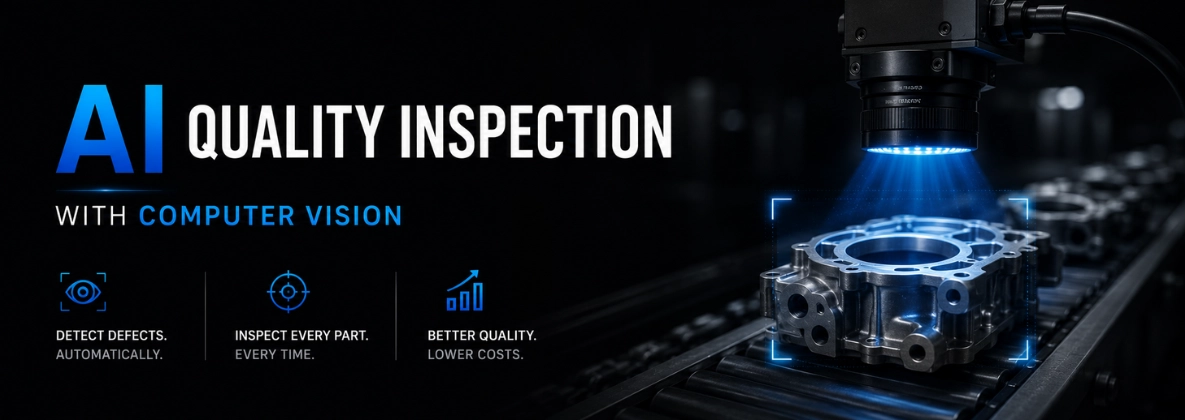
Walk onto a factory floor anywhere, and you will see a familiar scene: inspectors at the end of a production line manually checking components and marking them as pass or fail. It worked when production volumes were lower. At today's scale, it does not.
Manual inspection struggles to keep up because human attention declines during repetitive tasks, performance varies across shifts, and the naked eye cannot reliably detect micro-defects at machine speed. Studies show that inspectors can miss 20 to 30% of defects in real production environments, with accuracy falling further during extended shifts.
AI visual inspection changes that equation. It operates consistently, detects defects as small as 0.1mm, and inspects every product without fatigue or distraction. Once limited to global manufacturers such as Bosch and Foxconn, AI defect detection technology is now becoming accessible to Indian SMB manufacturers looking to improve quality, reduce waste, and scale efficiently.
Poor quality is more expensive than most manufacturers realise. Research shows that the Cost of Poor Quality (COPQ) can consume 15 to 20% of total sales through scrap, rework, returns, and warranty claims.
The problem has been rising. The order returns rate in India stood at 14.86%, and the quality requirements in various industries, including automobile, consumer goods, textile, and electronics, have increased. A product recall could cost companies millions, and a single poor-quality product could be sufficient to lose one-third of the consumers.
Channa Basava Rajan
Channa Basava Rajan shares practical guidance on AI-powered workflows and product delivery.

Manufacturing
Read insights and updates from Dhumi.

Manufacturing
Read insights and updates from Dhumi.

Manufacturing
Read insights and updates from Dhumi.
Furthermore, efforts being made by initiatives like PLI and Make in India are leading to the adoption of global quality inspection standards requiring digitization and audit-worthy information. Manual inspection fails to achieve these objectives. Automated quality inspection systems can.
Manual inspection challenges go beyond worker fatigue. Three structural issues limit its effectiveness.
Sampling VS Total Inspection
The common practice in most factories is the use of AQL Sampling, in which only a limited number of products are checked during the manufacturing process. Unfortunately, most defects tend to cluster, and hence, there is still a risk of approving batches that have inherent quality problems.
Inconsistent Classification
Inspection criteria vary widely across individual inspectors, different shifts, and working environments, making it increasingly difficult to attain the stringent quality requirements expected by the international OEMs.
Limited Traceability
Manual inspections may result in limited data, often kept manually, and fail to satisfy the ever-growing need for digital traceability in manufacturing industries, especially in the Automotive, Aerospace, and Pharmaceutical industry sectors.
AI-based defect detection requires more than the AI itself to be effective. The hardware, image processing, and AI need to work in concert to produce reliable outcomes.
Image Acquisition
High-resolution images are taken by industrial cameras of all products moving along the assembly line. Lighting plays an essential role in exposing defects that may have otherwise been overlooked.
Image Processing
Before the inspection, the images go through the process of cleaning and normalizing with techniques such as denoising, contrast equalization, and background removal to provide uniform input to the AI visual inspection system.
AI Detection
Using deep learning, the images are analyzed in real-time to identify whether there is any form of defect, such as scratches, cracks, contaminants, or missing parts. Defect detection through automation is able to identify defects as small as 0.1 mm and is even better than what human experts can achieve.
Action and Process Improvement
Where a defect is detected, the automated inspection system will initiate actions like alerting the concerned party, rejecting the defective item, and documenting important data. Such data will continue to enhance both the model and the production process.
The disparity in performance between manual and automatic quality inspection is great.
In a recent controlled experiment conducted in 2024, AI-based defect detection discovered 37% more serious defects than expert human inspectors, all other conditions being ideal.
Modern AI systems can achieve an accuracy rate of 95 to 99% when it comes to defect detection, can process over 10,000 pieces per hour, and can work around the clock without breaks.
Manufacturers who have implemented such systems have been able to reduce their defects up to 37%, customer complaints by 85%, and generate a return on investment of 374% over three years, with payback coming within 7 to 8 months.
Some industry giants have seen success with AI-powered visual inspection, too; for instance, Siemens has reported a 30% improvement in inspection accuracy, while Foxconn was able to improve its defect detection rate by 80%.
The technology of computer vision quality control is not one solution but an ability that can be applied to a specific environment with a measurable impact.
Automotive Sector: Inspection of surface defects, welding defects, casting defects, and painting defects. For instance, according to the news report in 2026, Maruti Suzuki teamed up with AI companies and improved the company’s visual AI inspections so that there would be zero defects in the production process. In addition, according to the news, BMW succeeded in reducing the defect rate by 60% thanks to AI visual inspection in automated quality inspection.
Electronics and PCB: Inspection of soldering defects, placements, and circuits better than humans can do, which includes chip-level AI defect detection.
Textiles and Garments: Inspection of weaving defects, color difference, broken threads, stitching defects, and other defects that will eventually develop into more serious issues.
FMCG and Packaging: Inspection of labeling defects, sealings, levels, and quality of printing of the package at production speed.
Pharmaceutical Products: Inspect tablets, blister packagings, and labeling of them by using AI visual inspection and automatically record audits of data.
Metals: Inspection of corrosion defects, welding defects, dimensional defects, and coating consistency via automated visual inspection.
77% of AI manufacturing pilot programs fail to make it past the prototype phase. Rarely does the issue lie with the technology. It lies with the intricacies surrounding its deployment.
Data bias: Since defects occur rarely, they create an imbalance in data. In this regard, for example, a manufacturing firm might have thousands of images depicting quality products and only hundreds of images depicting defective products. To address the issue, data augmentation, generation of defects, and transfer learning are key.
Before algorithms come optics: A successful project largely relies on camera positioning and lighting rather than the AI algorithm. Without a visible defect in the image, an automated defect detection algorithm will struggle regardless of how good it is.
Integration: An automated visual inspection system works only within a production environment, where it can be integrated into the manufacturing processes via PLC, ERP software, or a quality management system. Integration can prove challenging, particularly for companies with legacy systems.
The technology behind AI quality inspection is now mature and affordable. The real challenge for most manufacturers is turning inspection data into action.
AI visual inspection systems have provided valuable insights into defect rate, production line, shifts, and suppliers' quality. Most vendors end their service by supplying only the camera and AI system, but the manufacturers themselves would be responsible for managing the workflow process.
This is where Dhumi steps in.
A product for the manufacturing sector, Dhumi is an easy-to-use low-code AI software that enables the creation of workflows from automated quality inspection data. You will be able to build custom dashboards, detect defects, initiate a rework order, record rejects automatically, and get real-time notifications via WhatsApp or SMS messages, without having to write code.
Compliance reports based on ISO, IATF, or OEM regulations are generated automatically. Quality teams can set up rules like a defect-rate threshold within minutes instead of long development processes.
The aim for growing manufacturers is not an additional costly implementation of ERP. It is a useful software solution that will be set up easily and seamlessly with current workflows.
The AI quality inspection market is growing rapidly, driven by falling costs and proven business results. Manufacturers adopting AI defect detection and automated quality inspection are already reporting improvements in equipment effectiveness, shorter production cycles, and fewer unplanned stoppages.
The question is no longer whether AI visual inspection works. The real challenge is having the systems to turn inspection data into action.
Defect trends need to be visible before they become customer complaints. Alerts need to trigger immediate responses. Compliance reports need to be generated without manual effort.
Most inspection vendors provide the technology to identify defects. Dhumi provides the operational layer that helps manufacturers act on those insights through dashboards, automated workflows, and reporting built for day-to-day factory operations.