Most businesses don't start by wanting custom software. They start with a pile of spreadsheets, three tools that don't talk to each other, and a team re-entering the same order data twice a day. At some point the workaround costs more than a proper system would.
That is the moment custom software development services become worth a serious look. This guide explains what you actually get, how the software development lifecycle works from the buyer's side, what moves cost and timelines, and how to pick a partner in Bengaluru without regretting it six months in.
What custom software development services include
Custom software is built around your processes, data and users rather than a vendor's generic feature set. A full-service engagement usually covers:
- Discovery and consulting: mapping your workflows, pain points and success measures before any code is written.
- Product design: UX research, wireframes and interface design for the people who will use the system daily.
- Engineering: web applications, internal tools, portals, mobile apps and the backend services behind them.
- Integration: connecting the new system to your accounting software, payment gateways, CRM, ERP or legacy databases.
- Automation and AI: workflow automation, approvals, reporting dashboards and, where it earns its place, AI features such as document extraction or assistants.
- Quality assurance and security: functional, performance and security testing.
- Support: hosting, monitoring, bug fixes and planned enhancements after launch.
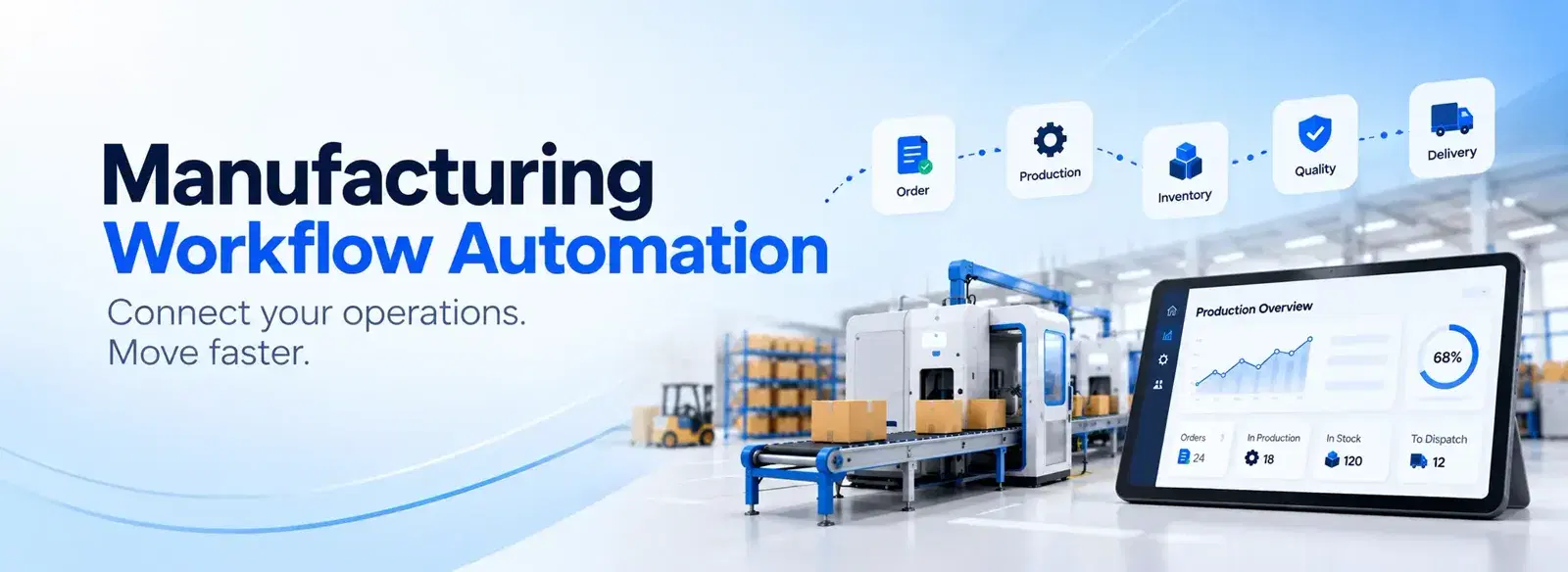
Typical outputs include manufacturing ERP systems, production tracking tools, CRM and lead management platforms, B2B ordering portals and operational dashboards. See how manufacturers use manufacturing workflow automation to connect work across teams.
Custom software vs off-the-shelf: how to decide
Custom is not automatically better. Off-the-shelf tools are faster to start and cheaper at the beginning. The question is where each approach starts to hurt.
| Question | Off-the-shelf usually wins when | Custom usually wins when |
|---|---|---|
| Process fit | Your process is standard and the tool matches it | Your process is a competitive advantage or unusual |
| Speed to start | You need something running this week | You can invest in a planned build |
| Integrations | Your stack is common and well supported | You rely on legacy systems or many point-to-point connections |
| Scaling | User count and data volume are modest | Per-user licences or workarounds grow faster than the business |
| Ownership | Vendor control is acceptable | You need control of the roadmap, data and IP |
A common middle path is to keep standard tools for commodity needs such as payroll or email, and build custom software only for the workflows that make your business different.
The software development lifecycle, step by step
The software development lifecycle (SDLC) is the sequence of phases a project passes through, from idea to a system that is running and maintained. Modern teams usually work in short Agile cycles rather than one long linear pass, but the same phases still apply. Here is what each one means for you.
- Discovery
- Planning
- Design
- Development
- Testing
- Deployment
- Maintenance
1. Discovery and requirements
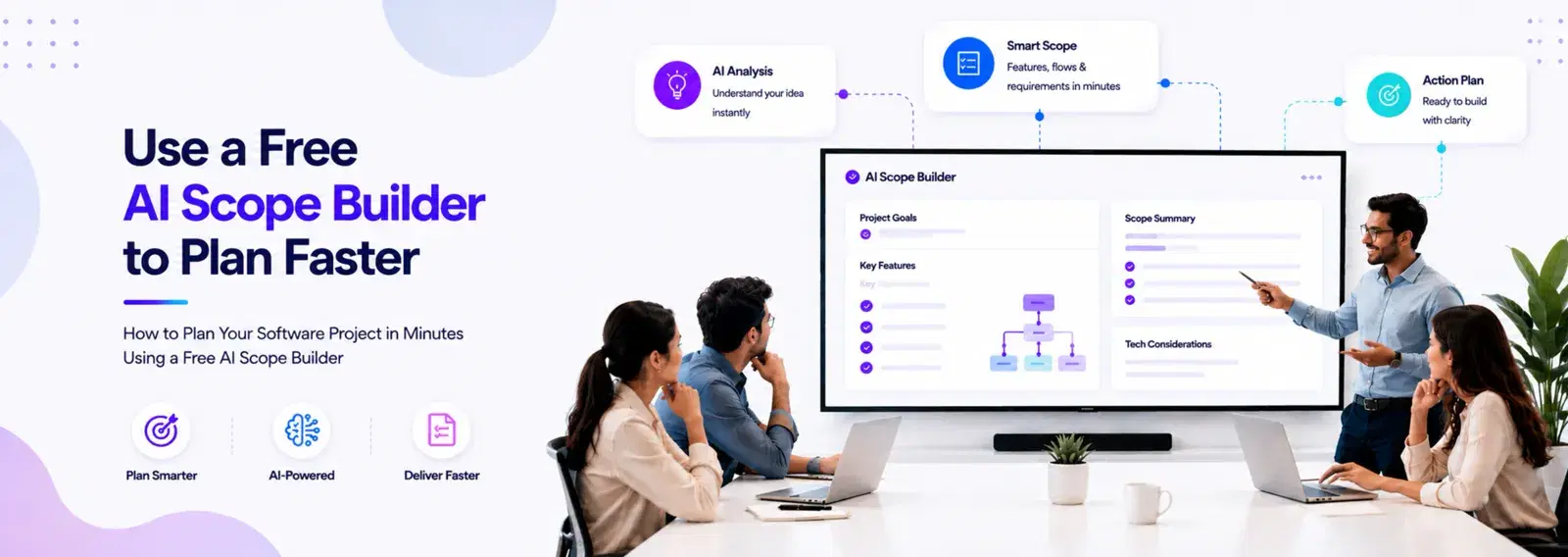
The team studies how work actually happens, who uses the system, and what a successful outcome looks like. Your job: give access to the people who do the work, not only managers, and share real documents, reports and spreadsheets. Output: a prioritised requirements list and agreed scope for a first release. A free AI scope builder can help you prepare for discovery.
2. Planning and architecture
The team chooses the technical approach, data model, integrations, hosting and security model, and breaks the work into milestones. Your job: flag compliance, data residency and integration constraints early. Changing architecture later is the most expensive kind of change.
3. UI/UX design
Wireframes and clickable prototypes let users react before development begins. Your job: put real end users in front of the prototype. A screen the founder likes but the warehouse team can't use is a failed screen.
4. Development
Engineers build in iterations, typically demonstrating working software every one to two weeks. Your job: attend the demos and give decisions quickly. Slow feedback is the most common hidden cause of delays.
5. Testing and quality assurance
Testing runs alongside development: functional checks, regression tests, performance tests and security review, followed by user acceptance testing with your team. Your job: test with realistic data and edge cases, not only the happy path.
6. Deployment
The release is planned: data migration, training, a rollback plan and often a phased rollout to one team or location first. Your job: decide who owns adoption internally. Software nobody uses has not been delivered.
7. Maintenance and iteration
After launch, real usage shows what to fix and what to build next. Expect monitoring, security patches, small enhancements and a roadmap for phase two. Agree on support terms and response times before you sign, not after go-live.
What drives cost and timeline
Any quote that arrives before discovery is a guess. Reliable estimates depend on these factors:
- Scope and number of user roles: each role usually means its own screens, permissions and workflows.
- Integrations: every connected system adds build and testing effort, and legacy systems add the most.
- Data migration: cleaning and moving existing data is often underestimated.
- Design depth: an internal tool and a customer-facing product need different levels of polish.
- Compliance and security needs: audit trails, access control and data protection add work.
- Team model and location: fixed-scope, time-and-materials and dedicated-team models allocate risk differently.
- Post-launch support: ongoing hosting and maintenance are part of the true total cost.
A useful way to control spend is to launch a focused first release, often called an MVP, then expand based on usage instead of building every idea up front.
Why Bengaluru is a strong base for custom software
Bengaluru has one of India's deepest pools of software engineers, designers and product managers, and a long record of serving startups, manufacturers and global clients. For a buyer that means more choice of specialisations, easier access to senior talent, and the option of meeting your team in person for workshops. It also means quality varies widely, which is why vetting matters.
How to choose a software development company in Bangalore
Directory rankings show who is listed, not who is right for you. Use this checklist:
- 1Relevant experience: ask for work in your domain or with a similar integration or workflow problem, and speak to a reference.
- 2Discovery-first approach: be cautious of firms that quote a fixed price before understanding your workflows.
- 3Transparent process: you should see regular demos, a visible backlog and named people accountable for delivery.
- 4Ownership and IP: confirm in writing that you own the source code, data and documentation.
- 5Security practices: ask how access, code review, testing and backups are handled.
- 6Post-launch support: look for defined response times and a clear plan for maintenance.
- 7Communication fit: the people you meet in sales should be reachable during delivery too.
Red flags: vague answers about who will actually build your product, no discovery phase, pressure to sign quickly, and reluctance to put ownership terms in the contract.
If you are comparing options, you can see how Dhumi works as a software development company in Bangalore alongside the others on your shortlist.
Common mistakes to avoid
- Starting with features instead of the business problem and the metric you want to move.
- Trying to build everything in version one.
- Excluding end users from design and testing.
- Treating launch as the finish line and not budgeting for maintenance.
- Choosing purely on the lowest quote, then paying for rework.
How Dhumi approaches custom software
Dhumi Technologies is a Bengaluru-based, AI-powered custom software development company building ERP and manufacturing systems, CRM and lead management software, B2B portals, business applications and AI-driven workflow automation, mainly for SMBs, manufacturers and growing businesses. The approach is the one described above: understand the workflow first, ship a focused release, then improve it with real usage. If you want to talk through whether custom software fits your situation, the team can walk through your current process and tell you plainly if an off-the-shelf tool would serve you better.
Frequently asked questions
What are custom software development services?
Custom software development services cover designing, building, testing, deploying and maintaining software made for one organisation's specific processes, rather than for a mass market.
How long does custom software development take?
It depends on scope, integrations and team size. A focused first release can often be delivered in a few months, while larger platforms are built in phases over a longer period. A discovery phase gives a realistic estimate.
How much do custom software development services cost in Bengaluru?
Cost depends on scope, number of user roles, integrations, data migration, design depth, compliance needs and support. Reputable firms estimate after discovery, not before, and many offer phased pricing.
What are the stages of the software development lifecycle?
The main stages are discovery and requirements, planning and architecture, design, development, testing, deployment, and maintenance. Agile teams repeat these in short cycles instead of running them once.
Is custom software better than off-the-shelf software?
Not always. Off-the-shelf suits standard processes and quick starts. Custom software suits unique workflows, complex integrations and cases where licence costs or workarounds grow with the business.
Who owns the source code of custom software?
Ownership depends on the contract. Ask for written confirmation that you own the code, data and documentation, and clarify rights to any third-party or reusable components.
How do I choose a software development company in Bangalore?
Check relevant experience and references, insist on a discovery phase, confirm ownership and security practices, review the support terms, and make sure the team you meet is the team that builds.