
Beyond Bandwidth: Rethinking Business Communication
May 1, 2026
5 mins

Loading blogs…
Fetching the latest posts
Loading article…
Fetching the latest content for you
May 1, 2026
5 mins
Written by
Dhumi Team
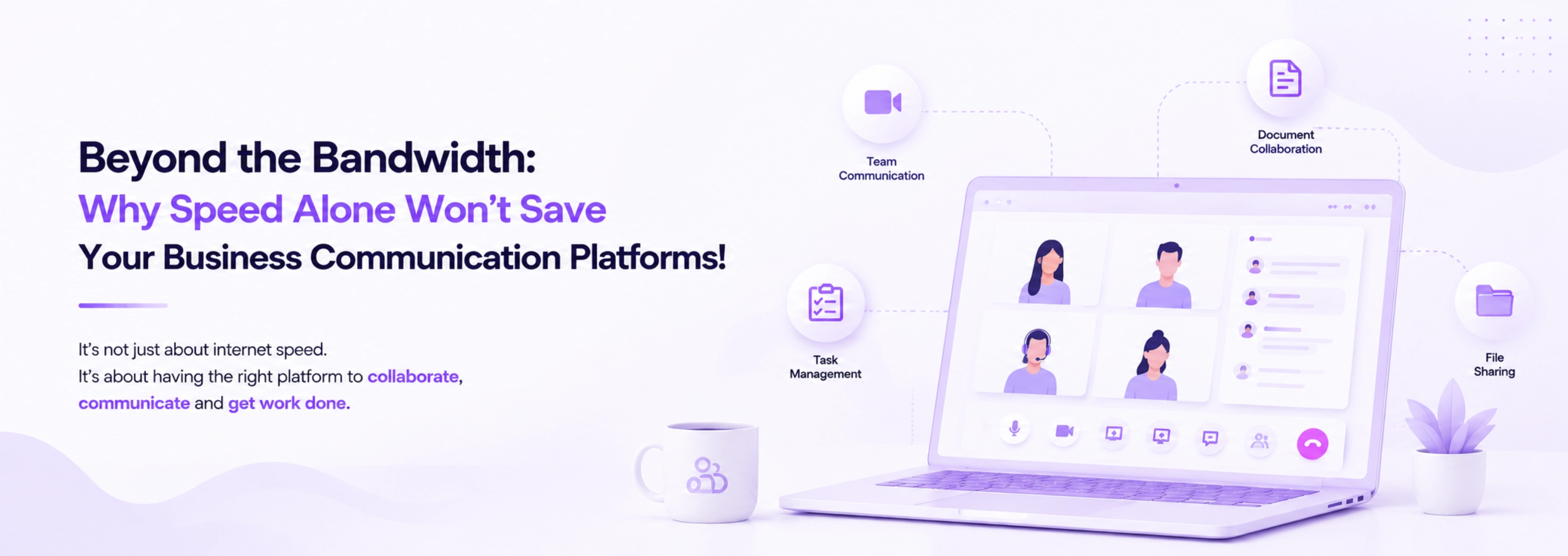
All organizations have experienced this. A client meeting halts mid-sentence due to network issues. Presenters for a webinar get disconnected one after the other. A board meeting ends up as a chorus of apologies like "Are you able to hear me?" The common reaction to this issue is always that there is something wrong with our internet speeds.
There may be some truth to this. However, the root cause of such problems is usually more intricate and involves a lack of effective communication and collaboration software, with different video, project management, communication, and storage software unable to work together. Bandwidth is essential, but it is not enough.
When there is a breakdown in virtual meetings, however, the fallout is far from fleeting. For businesses that operate in multiple time zones or are otherwise remote or hybrid by nature, the effectiveness of virtual collaboration is not a secondary issue. In many ways, it is their very essence and the reason why we need team collaboration tools.
Not all video calls need the same bandwidth. A personal call may only need 1 to 2 Mbps, but for an HD group discussion, it needs 5 to 10 Mbps, while a webinar with screen sharing would need more bandwidth. Apart from speed, some small factors matter, and that is, using a wired connection, closing background applications, and using good audio equipment will improve the experience. However, bandwidth is just one piece of the puzzle.
Dhumi Team
Dhumi Team shares practical guidance on AI-powered workflows and product delivery.

Video Conferencing
Read insights and updates from Dhumi.

Video Conferencing
Read insights and updates from Dhumi.

Video Conferencing
Read insights and updates from Dhumi.
Most of the teams operate on more than five platforms at once, starting from a video application, a chat service, a task management platform, a file storage platform, and an email service, all running concurrently. The use of each one seems logical enough. Together, however, they subtly undermine attention.
During the course of one meeting alone, an employee might change tabs multiple times simply to share a document, note down an action item, or follow up on some point that has come up in discussion. Changing focus undermines attention.
The ability to communicate, manage tasks, and share files within a single application transforms meetings from mere discussions into an opportunity to make real progress.
Task assignment becomes visible in the task manager immediately after it is assigned. File sharing becomes easy since no other application needs to be used. By the end of the meeting, you will have already made some progress.
That is precisely the challenge that Dhumi has been designed to overcome.
Dhumi is based on one core principle: the location for discussion must also be where collaboration takes place.
In contrast to other productivity solutions that require yet another platform to be added to the existing pile of applications, Dhumi integrates communication, task management, document storage, project collaboration, and workflow management in a single workspace. Fewer apps. Minimal switching. Meetings that conclude with action items being initiated right away.
The AI–powered, no-code engine manages all the routine processes such as scheduling, approval, updating, and routing tasks, requiring zero development and maintenance efforts from your IT department. The rest of the organization is free to think. For remote and hybrid teams, this feature is not a luxury. It is a necessity.
Distributed work isn’t going away anytime soon. For businesses in today’s era, distributed collaboration is just part of the new normal.
The teams that thrive in this setting aren’t those who have the fastest internet but rather those with the smarter solutions. No longer do they wonder how to solve their problems; instead, they ask themselves how to create the right environment for their people to excel.
The key is not in adding more platforms, but having the right platform. With the internet on your side, optimising collaboration software seems to be a wiser choice for the future transformation of operations.