A planner at a mid-sized plant gets three things in one morning: a machine goes down, a supplier pushes a delivery by two days, and a key customer pulls an order forward. Each event touches the schedule, the stock position and a promise to a customer. In most plants, someone reconciles all of it by hand across an ERP screen, a spreadsheet and a messaging group.
AI agents for manufacturing are built for this kind of cross-system, multi-step work. This guide explains what they are, where they pay off, what they need before you can trust them on a shop floor, and how to run a first pilot without joining the projects that get cancelled.
What are AI agents for manufacturing?
An AI agent is software that is given a goal, reads data from your systems, decides the next step, acts through tools such as your ERP, MES or maintenance system, and then checks the result and adjusts. Research on agentic AI usually names four ingredients: reasoning, planning, memory and tool use (Farahani et al., University of South Carolina).
The difference from tools you already have is easiest to see side by side.
| Tool | Best fit | Manufacturing example |
|---|---|---|
| Rule-based automation | Fixed, repeatable steps | Route a purchase request for approval |
| Machine learning model | Detecting patterns in one data stream | Flag unusual vibration readings |
| AI agent | Coordinating decisions across systems as conditions change | Propose a revised schedule after a machine goes down |
Be careful with labels. Gartner has pointed to "agent washing", where vendors relabel chatbots and RPA as agents, and has estimated that only about 130 of the thousands of agentic AI vendors offer genuine agentic capability.
Where AI agents fit in manufacturing operations
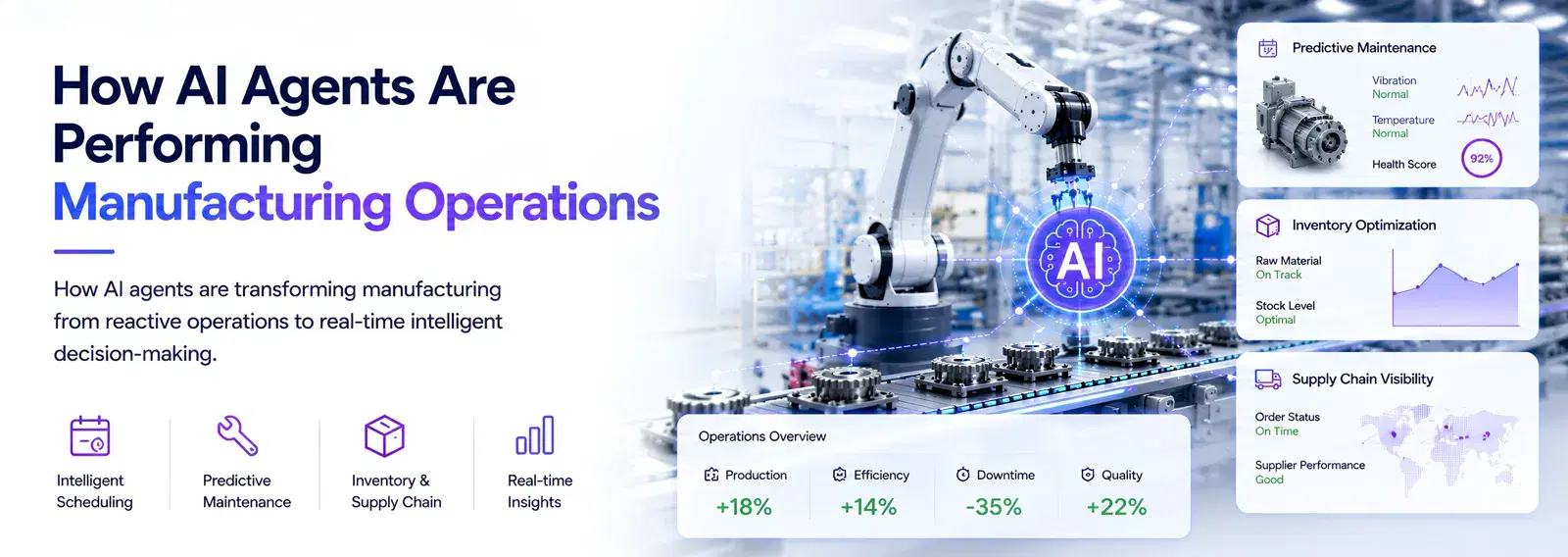
The best starting points are workflows that are repetitive, data-rich and slow because of coordination rather than because of physics. For a plant-floor view of the same ideas, read our piece on how AI agents are performing manufacturing operations.
Production scheduling and rescheduling
An agent watches orders, machine availability and material status. When something changes, it proposes a revised schedule, flags orders now at risk and drafts the messages to sales and stores. The planner reviews and approves.
Maintenance planning
NetSuite's overview of agentic AI in industrial machinery describes agents that turn condition data such as vibration and temperature into work orders and schedule adjustments. In practice the agent combines sensor trends with maintenance history, suggests the likely cause and parts needed, and finds a slot that disturbs production least.
Quality deviations
When inspection results drift, an agent can pull the related batch, material and shift data, draft the deviation report and suggest containment steps. A quality engineer signs off.
Procurement and inventory
Compare stock against the bill of materials and open orders, chase suppliers, flag shortages before they stop a line, and draft purchase requests for approval. For the stock side in more detail, see how AI improves inventory management in manufacturing.
Supervisor and operator support
Supervisors can ask for production status, work orders or SOP steps in plain language, in the language the floor actually uses, and have shift handovers logged automatically.
AI solutions for manufacturing: when an agent is the right tool
Not every problem needs an agent. A simple way to choose:
- Fixed, high-volume, predictable steps: use ERP workflows or rule-based automation.
- Pattern detection in one data stream (visual inspection, anomaly detection): use a machine learning model.
- Coordination across several systems when conditions keep changing: use an agent.
Most plants end up combining these: the ERP as system of record, models for detection, and agents coordinating the response. Gartner's advice is to pursue agentic AI only where it delivers clear value or return on investment, which is a sound filter for any manufacturer.
If you are mapping where to begin, our guides to manufacturing process automation opportunities and manufacturing workflow automation cover the steps that come before an agent.
What an agent needs before it can work on your shop floor
- Reliable data. An agent working on inconsistent stock or maintenance records will be confidently wrong. Dhumi's Data for AI work focuses on getting this foundation right.
- Integration with ERP and MES. Gartner notes that connecting agents to legacy systems can be technically complex and disruptive to workflows, so budget for it. An agent should connect to your existing manufacturing ERP and other integrations, not replace them.
- Defined authority. Decide what it may do alone (draft, recommend), what needs approval (change a schedule, raise a purchase order) and what is off limits.
- An audit trail and rollback. Every action logged, every change reversible.
- A named owner. One person accountable for the workflow and for reviewing the agent's mistakes.
Why many agent projects stall
In June 2025 Gartner predicted that over 40% of agentic AI projects will be cancelled by the end of 2027, citing rising costs, unclear business value and weak risk controls. On a plant floor that usually looks like: starting with a showy autonomous use case instead of a measured problem, having no baseline to compare against, and giving an agent system access before governance is in place.
How to run a first pilot
- 1Pick one workflow with a measurable cost, such as response time to unplanned stoppages, rescheduling effort per week or shortage-related line stops. Record the baseline.
- 2Map the decision: inputs, systems touched, who approves, and the common exceptions.
- 3Fix data gaps for that workflow only, not the whole plant.
- 4Launch in recommend mode. The agent drafts, a person approves. Tools such as Dhumi Flow can handle the approval workflow around it.
- 5Review weekly against the baseline, including every wrong call.
- 6Widen authority only for actions with a proven record.
How to choose an AI agent development company
The market is crowded, so shortlist an AI agent development company on evidence rather than demos. Ask:
- Can they show agents running in production with ERP or MES integrations?
- Do they understand bills of materials, routings and work orders, or only chat interfaces?
- How do they handle permissions, logging and rollback?
- Will they begin with one workflow and a baseline?
- Who owns the code and the data?
- What happens when the model is wrong?
AI agents for manufacturing in Bengaluru
Bengaluru's industrial areas, such as Peenya, and the aerospace, electronics and precision-engineering supplier base around the city, share a pattern: many plants run a mix of ERP, accounting software and spreadsheets, and a few experienced planners hold much of the operating knowledge. That shapes what works. Start small, connect to whatever system of record already exists, support the language the shop floor uses, and design agents that work alongside planners rather than replace them.
When comparing an AI agent development company in Bengaluru, ask about on-site commissioning and about support hours that match your shifts. Agentic AI services in Bengaluru should cover use-case discovery, data readiness, agent build, system integration and ongoing monitoring, not just a prototype.
Real examples help when you are comparing partners. Dhumi has built an AI platform for manufacturing operations and pricing, worked on complex operations for a precision manufacturer, and set up post-delivery service for an equipment maker.
Dhumi Technologies builds AI agents and workflow automation alongside manufacturing ERP and production-tracking software, so agents can sit on top of the system where production data already lives. If you are evaluating AI solutions for manufacturing companies in Bangalore, begin with the one workflow that costs you the most time today. You can also see how Dhumi applies AI agents for business, or talk to our team.
Frequently asked questions
What are AI agents in manufacturing?
Software that takes a goal such as keeping a schedule on track, reads data from systems like ERP, MES and maintenance records, decides the next step and acts through those systems within set limits, usually with human approval for important actions.
How are AI agents different from automation or RPA?
Rule-based automation follows fixed steps and breaks when conditions change. An agent can reason about a new situation, choose between steps and adapt, but it needs stronger data, integration and guardrails.
Which manufacturing processes are best for a first AI agent?
Workflows that are repetitive, data-rich and slowed by coordination: rescheduling after disruptions, maintenance work orders, deviation reporting, shortage alerts and supplier follow-up.
Do I need to replace my ERP or MES to use AI agents?
No. Agents usually sit on top of existing systems through integrations. What matters is that the data they read is accurate and that they can write back through controlled actions.
Is it safe to let AI agents act on the shop floor?
Keep agents on planning and information tasks, start in recommend-only mode, log every action and require approval for changes that affect cost, customers or safety. Machine control and safety interlocks should stay with dedicated control systems.
How long does a first pilot take?
It depends mainly on data readiness and integration effort. A single-workflow pilot is typically scoped in weeks to a few months, and a defined baseline lets you judge results objectively.
What should I look for in an AI agent development company in Bengaluru?
Evidence of agents running in production, ERP and MES integration experience, clear permission and audit controls, willingness to start with one measurable workflow, and support that fits your shift timings and on-site needs.
Sources
- Gartner, "Gartner Predicts Over 40% of Agentic AI Projects Will Be Canceled by End of 2027," press release, 25 June 2025: https://www.gartner.com/en/newsroom/press-releases/2025-06-25-gartner-predicts-over-40-percent-of-agentic-ai-projects-will-be-canceled-by-end-of-2027
- Farahani, Khan and Wuest, "Hybrid Agentic AI and Multi-Agent Systems in Smart Manufacturing," University of South Carolina (arXiv): https://arxiv.org/pdf/2511.18258
- NetSuite, "Agentic AI in Industrial Machinery": https://www.netsuite.com/portal/resource/articles/business-strategy/industrial-machinery-agentic-ai.shtml