
What Is Healthcare Automation and Why Does It Matter?
July 16, 2026
5 minutes

Loading blogs…
Fetching the latest posts
Loading article…
Fetching the latest content for you
July 16, 2026
5 minutes
Written by
Enosh Cherukuru
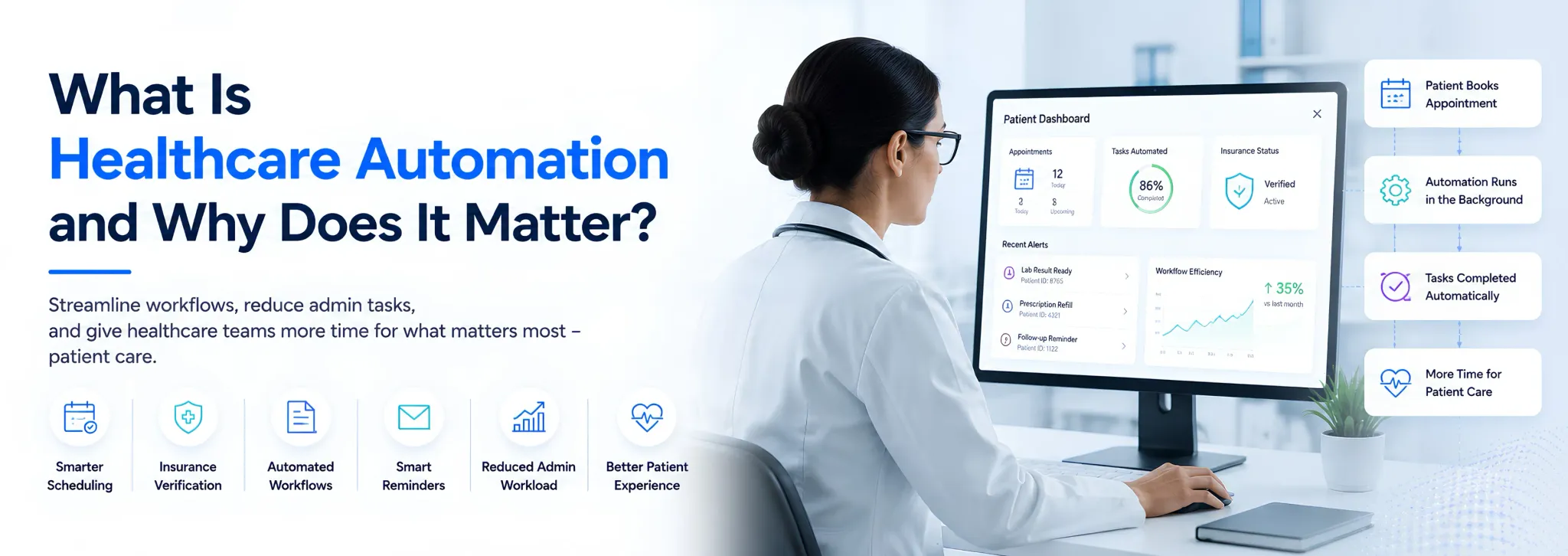
A nurse at a mid-sized clinic spends the first hour of her shift not treating patients, but doing paperwork. Insurance forms. Appointment reminders that never got sent. A lab result sitting in an inbox nobody checked overnight. Now multiply that hour across every staff member, every day. That's why healthcare, a field built around caring for people, ends up spending so much of its time on things that have nothing to do with care at all.
This is the problem healthcare automation is built to fix. Once you see it, you can't unsee it.
Healthcare automation means using software and AI tools to handle repeat, rule-based tasks in a healthcare setting, so staff get more time back for actual patient care. Think appointment booking, insurance checks, patient intake forms, billing codes, prescription refill requests, and follow-up reminders. None of these tasks need a doctor's judgment. But all of them still eat up a doctor's day.
At its core, healthcare automation works like automation anywhere else: a system watches for a trigger (a new booking, a lab result coming in, an insurance claim being filed) and then runs a set of steps on its own, no human needed to push it along. The difference in healthcare is what's at stake. A missed step in an online order is annoying. A missed step in a patient's care can be dangerous. That's why healthcare automation needs extra care, extra attention to rules, and room for a human to step in when something looks wrong.
Healthcare staff shortages aren't a future problem, they're happening now, and too much admin work is making it worse. Studies on clinician burnout keep pointing to time spent on paperwork as one of the biggest causes of exhaustion. When a doctor spends nearly two hours on paperwork for every hour spent with patients, something in the system is broken. And it isn't the doctor.
Healthcare automation matters because it fixes that imbalance directly. It doesn't replace a doctor's judgment. It clears the clutter around it. A well-automated healthcare workflow means a patient's intake form fills itself in from their record, their insurance gets checked before they walk in, their appointment reminder goes out without anyone typing it, and their lab results reach the right person the moment they're ready. None of that needs AI to make a medical call. It just needs the system to stop making people do work a machine can do faster and more reliably.
Enosh Cherukuru
Enosh Cherukuru shares practical guidance on AI-powered workflows and product delivery.
Workflow automation for healthcare usually follows one simple pattern: trigger, action, handoff. Something happens (a patient books a visit, a claim gets filed, a prescription runs low), the system takes a set action (send a reminder, check coverage, flag it for review), and if anything looks unusual, it hands the case to a human instead of guessing.
A few places where workflow automation in healthcare shows up in real life:
None of this replaces a clinician's judgment. It just clears away the busywork wrapped around that judgment, which is usually where healthcare workflows break down.
| Manual Process | Automated Process | |
|---|---|---|
| Patient intake | Staff re-types data from paper forms | Data fills in from past records |
| Insurance check | Done after or during the visit, causing delays | Done before the appointment |
| Appointment reminders | Called or emailed by hand | Sent on their own, on schedule |
| Lab result routing | Checked and forwarded by hand | Sent instantly to the right provider |
| Paperwork | Filled out from scratch each visit | Pre-filled based on visit type |
| Staff time cost | High, repetitive, error-prone | Low, steady, freed up for patients |
The pattern in every row is the same: automation doesn't remove the person, it removes the repeat work.
Healthcare workflows rarely stay in one department. A single visit touches scheduling, front-desk billing, clinical notes, lab or pharmacy coordination, and sometimes insurance follow-up after the fact too. When each of those steps gets passed by hand from person to person, delays and mistakes are almost guaranteed. Automation links those steps so information moves on its own, and staff only step in when their skills are actually needed, not to carry data from one place to another.
This is also where many clinics get stuck. They know their workflows are slow, but building custom software feels out of reach without a big IT budget or a full development team. That's where a low-code approach helps. Instead of a year-long build, a clinic can set up automated workflows for intake, reminders, and billing checks using tools made for people who aren't developers, and adjust them as things change.
Does healthcare automation replace doctors or nurses?
No. Healthcare automation handles admin tasks like scheduling, reminders, and data entry, not medical decisions. The goal is to give clinical staff back the time paperwork takes from patient care, not to replace their judgment.
Is healthcare automation safe enough for patient data?
It can be, as long as the tools are built with healthcare rules in mind, including data encryption, access controls, and activity logs. Any tool that touches patient data should be checked against the right data protection standards before it's used on real records.
What's the difference between healthcare automation and telemedicine?
Telemedicine means delivering care from a distance, through video or messages. Healthcare automation means smoothing out the admin and workflow tasks around care, whether that care happens in person or remotely. The two often work side by side, but they solve different problems.
How much time can healthcare automation actually save?
It depends on the clinic's size and how complex the workflow is, but the biggest gains usually come from the most repeated tasks, like insurance checks and appointment reminders. Even automating two or three of the most annoying steps in a patient's visit can free up several hours of staff time each week.
Do small clinics need a big IT team to automate healthcare workflows?
Not anymore. Low-code tools let staff without a tech background set up and adjust workflows without writing code, which makes healthcare automation realistic for small practices too, not just big hospitals.
If any of this sounds like your clinic's Monday, the good news is you don't have to automate everything at once. Start with the one task that eats the most staff time, often insurance checks or appointment reminders, and build from there. Dhumi workflow automation tools are built for exactly this kind of step-by-step, low-code rollout, so healthcare teams can automate the repetitive parts of patient care without needing a development team. If you want to see what that could look like for your practice, Dhumi's AI App Generator is a natural next step for building custom workflow tools without a full engineering build.
This piece pairs well with Dhumi's other posts on AI automation and low-code tools, worth a look if you're thinking about where automation fits beyond healthcare too.
